A few seats are left in this online workshop with a small group of writers. Join Little Frankensteins: The Next Creation and find out how playing with genre and constraints can amp up the energy of your poetry and prose. Send me an email to apply.


Author, Poet, Speaker, Book Coach, Editor
A few seats are left in this online workshop with a small group of writers. Join Little Frankensteins: The Next Creation and find out how playing with genre and constraints can amp up the energy of your poetry and prose. Send me an email to apply.
I forget how delicate you are
fooled again
I see only the warrior, the bull,
the brawn, the bluster
muscles, rippling
sinews taught
jets of steaming breath
issuing from within.
Then I remember
the silk moths.
Remember when you brought home from the weaving village
the half a dozen wide
round trays
woven circles of smoke-dark bamboo
scores of fat little lozenges of living silk
Cocoons spiraling between low walls to keep the worms
from tangling together as they spun their snug homes?
We watched for weeks the creamy soft coffins
fat and shiny with life, until we
saw them crack, open all at once
black eyes in strange small white heads,
looking lidless into the light
feathery furred wings pushing out, straining to be free,
then the cloud of them fluttering up,
flickering in the sunshine above.
In their dance of delight and desire
they coupled quickly
Bodies touching briefly then,
wild fluttering slowed,
came quiet back to earth
wing beats soft like panting,
like trying to catch their breath
after so much life
until they stopped
lay still,
and there
bodies that had moments before held such fiery life,
didn’t simply die, but
crumbled
fell away like dust,
leaving nothing but
hundreds of tiny eggs,
mounds of wet seeds
purple glistening, progeny.
You and I are
No less
No more
and I am
sorry
that I so often
forget.

Over two months ago, the day after Thanksgiving, the phone at my mountain-top retreat in Taos rang at two AM. I picked up and heard the sound of my 27-year-old son’s voice. He told me that his aunt had just called him from Thailand to let him know that his father, the man I had been married to for 23 years, had died at home in the town where he grew up, where I met him, where we fell in love and started our family. It was a complete shock. Dtaw had always been a dedicated athlete who still ran and biked long distances. He had finally begun to find joy in his life after so many years of grieving over the loss of our son and the subsequent dissolution of our family ties.
By the time I hung up the phone hours later, Cody and Tahn and I had decided to fly that day to Thailand for the funeral. I was not sure how I would be received by our family and community there, having been the one to have left Dtaw nearly ten years ago, but I knew I had to be there for my boys, now devastated.
48 hours later, after landing in Bangkok and flying to the Northeast edge of Thailand where Dtaw’s hometown stood on the edge of the Mekong River, the boys and I arrived at the funeral. Being back “home” where Chan had been born (in the same bed where his dad had died) and in the same house where his funeral had been 18 years before triggered an explosion of memories. Every shop, every street corner, every view of the clouds over the river reminded me of memories of my life as a young woman falling in love, a young mother delighted with her brood, an exhausted mother fighting for Chan’s life, and a heartbroken mother, contending with his death.
Despite all this inner turmoil, I knew it was right to have come for the funeral. Dtaw’s family and many friends and neighbors surprised me with the gracious warmth and love they offered, the genuine pleasure they seemed to take in my return, welcoming me as if I’d never left them, as if I’d never left him.

They even insisted I take the place of honor as head mourner in each part of the week-long funeral ceremonies, leading the procession at the temple, sitting closest to the coffin at home when the monks chanted, being the first in line to present offerings to the monks. This might seem odd in our culture, but I think that there, the family unit is so fundamental, that the fact that I was the mother of his children outweighed any subsequent arrangements we may have made about our living situations.
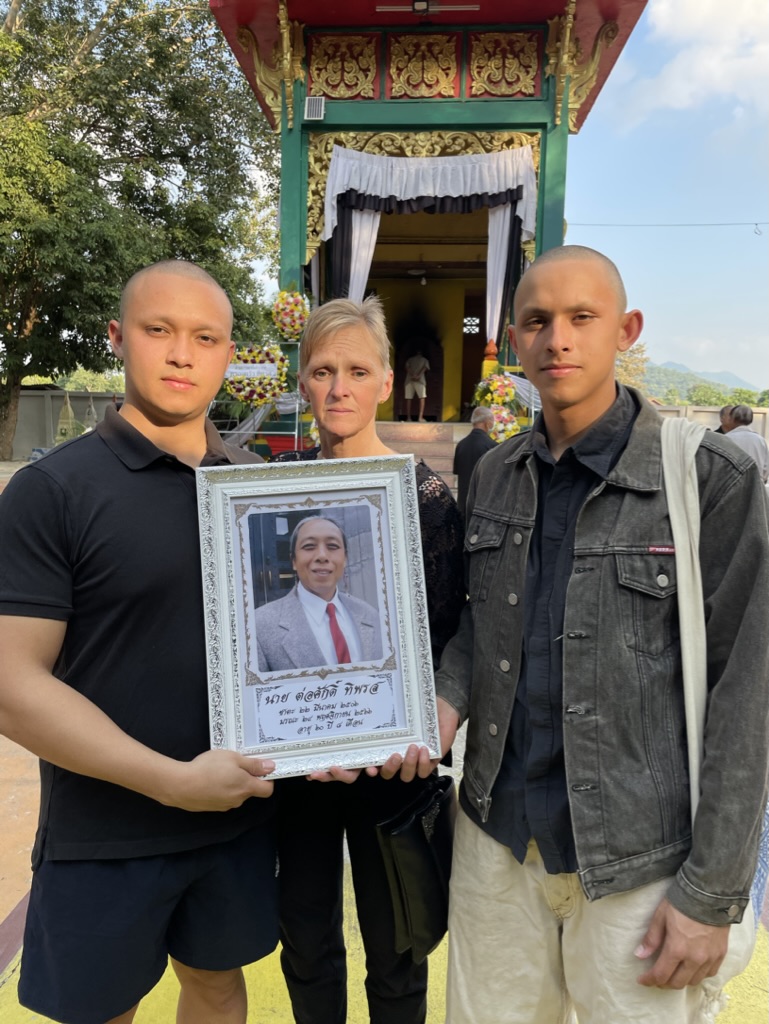
It was humbling to be treated with such kindness and to remember what strong and abundant ties I had and still have to that community. I have Dtaw to thank for that. When we fell in love, he opened to me not only his heart, but also the family and culture that was so dear to him. I will be forever grateful for the way his acceptance and education of me changed my life by showing me a new perspective on the world I thought I knew.
In the weeks before Dtaw’s death, I found myself feeling a new sense of gratitude for him, I found myself writing about the early days of our relationship, about the sweetness, about the wonder of parenting with someone I loved so much. The boys and I had planned to go visit him this March, and I was looking forward to connecting with him now that the wounds of divorce had had time to heal. The night before he died, I even dreamed of him, and in the dream I experienced a sense of deep appreciation for the way he always loved me, showing his devotion through wordless acts of kindness. From him I learned how to give, how to be supportive and how to be patient. For this and for so much more, I will always be grateful.
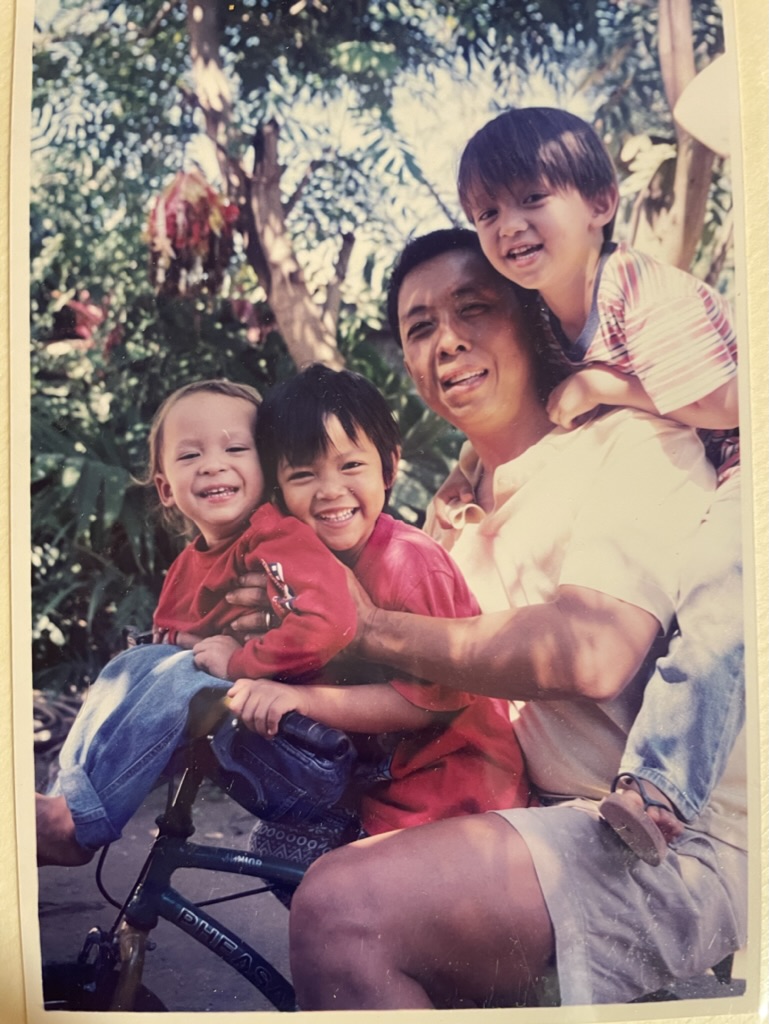
Dtaw Tiparos, March 22, 1963 – November 23, 2023
To contribute in Dtaw’s memory to the Wat Tah Kek School to provide a home, education and skills for a hopeful future for poor and abandoned children, click here.
In case you are not subscribed to my newsletter, here’s the latest…

Continuing the fun and unbelievably effective format poet Sarah Carson and I have been teaching with our Little Frankensteins classes, we have decided to team up to offer a one-time 90-minute workshop for people who would like to see what all the fun is about.
Come experiment beyond the boundaries of poetry and prose, learn strategies to make play and discovery part of your writing practice.
The workshop will include time for in-class writing as well as exercises you can continue beyond the class.
Click here for more information and to register.
If you would like to spend more than one evening as part of this process of finding the unexpected while amping up the creativity of your writing, join our 5-week asynchronous workshop in February…
February 5th – March 3rd
Asynchronous

You will receive the lessons and assignments in your inbox each week and participate in group discussion boards for support and feedback from award-winning poet Sarah Carson and me on your work.
Click here for more information and to register.
And finally…

Sarah Carson and I are curating this wonderful new website. Each week OK FRANK will feature the work of a writer or poet who is bending the traditional rules of genre to produce exciting and inspiring short pieces of work. Along with the poem or prose of the week, will be a message from the creator about how the particular piece came about.
Visit OKFRANK.COM to see what it’s all about.
Subscribe to get a new and innovative short something in your inbox each week.
OKFRANK.COM is ad-free!
I am honored to share this essay by my friend Dr. Lenna Liu of Seattle, Washington from today’s edition of the South Seattle Emerald
.
by Lenna Liu
The Rev. Dr. Martin Luther King Jr.’s portrait hung in the entryway of Odessa Brown Children’s Clinic’s (OBCC) Central District location where I spent most of my 30-year pediatric career. Birthed during the Civil Rights era for Seattle’s Black community, this beloved clinic was where I had my education in Black history. It was here where we celebrated Juneteenth, singing “Lift Every Voice and Sing” decades before Juneteenth became a federal holiday. It was here, where our motto has been “quality care with dignity,” that I practiced seeing the dignity inherent in every person, no matter their circumstances. It was here where I grew to understand how much of the “dis-ease” we see in medicine is the impact of social determinants of health, such as poverty, oppression, and trauma. It was here where I learned in real day-to-day tangible ways how the history of Black Americans has continued to play out as lingering inequities in housing, schooling, and even access to healthy foods, decades after our country has been trying to right these wrongs.
Seeing these struggles, I was always asking myself, “How can I possibly help families whose struggles and concerns feel beyond the scope of a clinic room and for which there are no treatments or medication?” As pediatricians, we are trained to be advocates, to work beyond the clinic walls to speak out for policies and legislation that support children and families. But advocacy and policy change take time, often a long time. I struggled with knowing what to do in the moment when I could see the sleepless worry and fatigue in a parent’s eyes right in front of me.
Sometimes answers come in the midst of our own deepest suffering. In the middle of my career, my marriage fell apart, and I found myself lost, unmoored, and deeply grieving the loss of my dreams for my children and myself. It was during this time that I had to learn the deep inner work of healing. I had been practicing yoga for exercise and relaxation, but during this time, yoga became something much more than exercise. As I moved through yoga poses, opening and stretching my body, tears would suddenly appear and begin to fall — a physical and emotional release I did not know my body needed. When I sat in the final minutes of meditation after an hour of mindfully moving my body with breath, I felt moments of calm and the sense of coming back to myself again.
I knew these skills of meditation and mindfulness were something I had been missing in my life. To learn how to slow down, to be with complicated emotions, to not abandon myself or ignore what my stressed body was telling me were all essential to my well-being. These practices also invited me to look more deeply at parts of myself that were hard to look at: my tendency to overdo and then hold it against others for not doing their part; feeling judgmental of others for qualities in myself that I was unwilling to see; learning to forgive others and myself. In addition, I grew to see the parallel between understanding myself and how I interacted with those around me. Learning to have more compassion for myself, I became even more compassionate to others. Learning to see and forgive myself for mistakes I made, I was more able to forgive others for theirs. Learning these practices changed my life — they changed my ability to navigate life and deepened all the relationships around me.
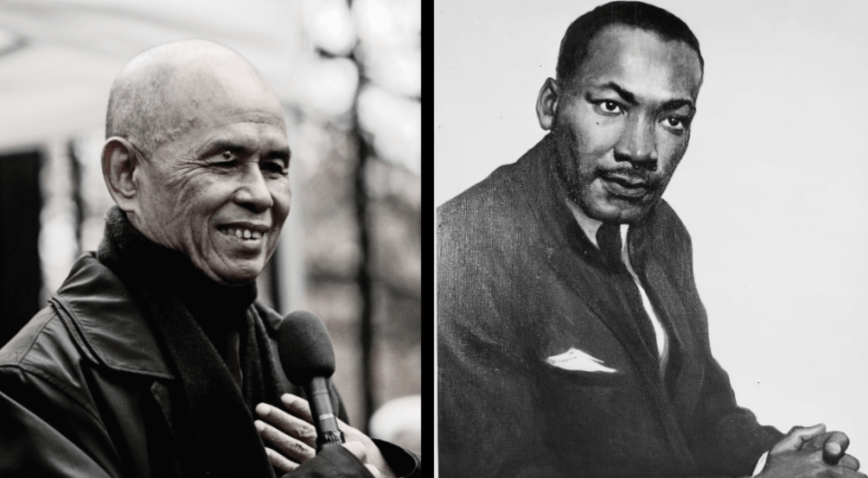
I am inspired by another photo of Martin Luther King Jr. In this photo, he sits next to the great Buddhist teacher often called “the father of mindfulness,” Thich Nhất Hạnh, at their first meeting in Chicago, 1966. Despite their very different backgrounds — a Black Baptist minister leading the Civil Rights Movement and a Vietnamese Buddhist monk calling for peace during the Vietnam War — they recognized in each other a kindred spirit working toward justice. As a pediatrician working in a clinic birthed during the Civil Rights era, the image of these two visionary leaders working together inspired me in merging the inner work of mindfulness and compassion with the outer work of building community and social justice.
After years of my own healing, I resolved to find a way to bring mindfulness practices to support the well-being of families at my clinic. I knew that reducing the stress of parents would help their children. However, I also knew that most of my families lacked access to these practices. Yoga and mindfulness classes can be expensive, feel exclusive, and are indulgences for many. They should not be. During this time, several local parents of children with disabilities were also searching for something to help them cope with the stress and challenges of their days. They found a course on mindful self-compassion and were struck by how these self-compassion practices were one of the first things they had ever found to help, a balm for the isolation and lack of understanding they felt in other parts of their lives. In 2017, several OBCC and Seattle Children’s health care providers partnered with these parents in a grassroots effort to create a mindfulness and compassion program for parents that we brought to OBCC.
These parent facilitators, mostly Women of Color, were also community leaders and organizers, already deeply skilled in building community and holding space for listening and supporting others. In our sessions, we shared mindfulness practices with interested parents and caregivers. We gave space for participants to share how they were doing and for others to listen deeply with an open heart. Instead of facing their challenges alone and in isolation, we found a sense of common humanity in these sessions, a shared sense of facing life’s joys and hardships in community.
I learned so much from these parents and these practices, a very different kind of knowledge than I learned in medical school. These skills complemented the science of medicine with the art of living and grew my capacity to be a doctor who could be present — really show up for my families and see and hear them, to listen in a way that was being squeezed out of health care as we were rushed to see more patients in shorter periods of time. It allowed me to continue to prioritize “quality care with dignity” — bearing witness to another person, hearing their stories with an open heart, holding space for the complexities of their lives, showing reverence for what they endured. During these times when many are experiencing an absence of feeling seen or being heard, our presence for each other’s inherent dignity, this witnessing, is a profound gift of healing.
Our team accelerated our efforts at the beginning of the pandemic in 2020, offering free weekly mindfulness drop-in sessions online. Then, after George Floyd’s murder, we recognized the importance of offering classes by Black parent facilitators for the Black community, while also offering classes (adapted by language and culture) led by Spanish-speaking and Somali parent facilitators for their respective communities. Unfortunately, our program was recently ended due to OBCC budgetary constraints; our team is saddened that we are no longer able to share this foundational practice of well-being with more parents and caregivers. But I also know the seeds of mindfulness we planted during these past seven years, and particularly during the pandemic, will root and grow when conditions are right and will continue to support those we reached and perhaps beyond.
On this day of honoring the Rev. Dr. Martin Luther King Jr., and nearly two years after the passing of Thich Nhất Hạnh, I write to share this story and to honor both men at a time when we urgently need their teachings and guidance.
As I think about them, their teachings about Beloved Community rise to the fore. The divisiveness that permeates our world right now masks our common humanity. As a pediatrician surrounded by newborns, children, and their parents, I was reminded daily that we share the same hopes and fears. The vulnerability we feel as we become parents is the shared reality of our lives. There is a deep fragility to our human condition, yet newborns, children, and each of us are also remarkably resilient and strong. To survive and feel safe, we often dichotomize and reduce life, or each other, to good or bad and safe or unsafe, but in reality, life is not that simple. Rather, life, and each of us, is exceptionally complex, many-layered, and we need to build our capacity to hold ever greater complexity and nuance.
How can we build this capacity to see the dignity and complexity in each other? I witnessed and experienced these small acts of collective healing in our mindfulness classes and know these are some of the ingredients needed for what is ahead. The meeting of these two great men can be a reminder to all of us of the necessity of inner healing and collective action, and that the two are not separate, but are essential pieces for ourselves, for our children, and for our world.
The South Seattle Emerald is committed to holding space for a variety of viewpoints within our community, with the understanding that differing perspectives do not negate mutual respect amongst community members.
The opinions, beliefs, and viewpoints expressed by the contributors on this website do not necessarily reflect the opinions, beliefs, and viewpoints of the Emerald or official policies of the Emerald.
Lenna Liu is an emerging writer and a retired University of Washington emeritus professor and pediatrician who cared for children and families at Odessa Brown Children’s Clinic for over 30 years.
📸 Featured Image: Left: Thich Nhất Hạnh in Paris, France, in 2006. Photo is attributed to Duc (pixiduc) (under a Creative Commons, CC BY-SA 2.0 DEED license). Right: Portrait of Martin Luther King Jr. by Betsy Graves Reyneau, part of the exhibition “Portraits of Outstanding Americans of Negro Origin.” (Photo courtesy of National Archives, photo no. 559202.)
 Catharine H. Murray
.jpg)