What if?

With all the outpouring of support, feet coming through the door, standing on the floor an hour or more, and then the words that they gave me,
You are an inspiration.
I feel full of hope and joy.
Thank you for your invitation to grieve
For being a truth-teller.
I wonder,
What if my circle of dreaming women hadn’t dragged me out of the dark, safe quiet place where I wrote and never showed anyone?
What if my friend hadn’t told me a few years ago that I needed to go to graduate school in creative writing? What if she had let me quit when I couldn’t see the sense in all that debt? What if that woman we knew hadn’t listened to her heart and taken the path toward her art, forsaking her job to write her book and found her way?
My friend could not have pointed to her and said, “Look how happy she is. You need to do it. You need to be who you were meant to be.” And then when I was sure it was all a waste of time and money to spend on nothing more than trying to write something too hard to write anyway, my grad school buddy said, “No way. You cannot quit. You have to finish. I won’t let you quit.”
Because of them and so many others pushing me when I wanted to take the easy out, I didn’t give up.
I wanted to, so many late nights, so many difficult days.  Until the work was finally done.
And now here I am with all this love and appreciation raining down on me
And now I let it soak my tired skin
Drink it in
And thank everyone and everything.

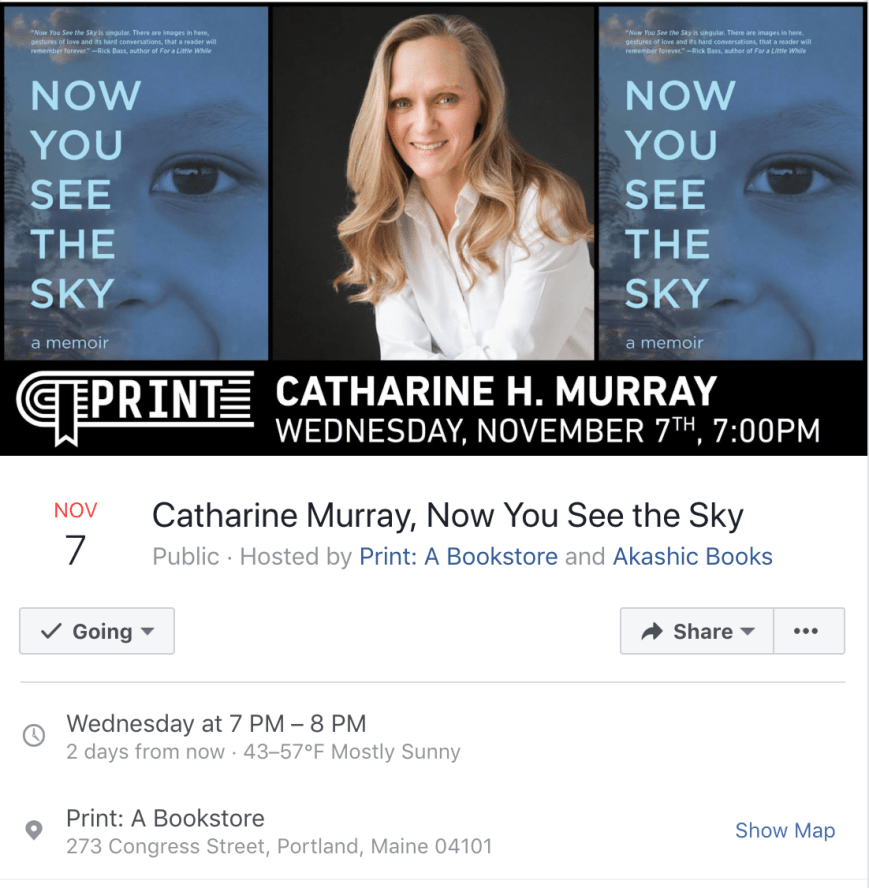
Print bookstore 11.7.2018-14

My Book Birth-Day is almost here.

I am getting nervous and excited. What a thing to let this go after so many years of dreaming, drafting, ego-squeezing submitting, editing, crafting and now finally, releasing. And all of it begotten by deep grief. The work of writing is what carried me into and through the grief in a way that sent me out healed. And here I am on the other side. I hope all my local people can make it to the party to help me celebrate this milestone of this journey.


Release Party! November 7th at 7 p.m.

I am delighted to announce that Print: A Bookstore in Portland, Maine will host the release party for Now You See the Sky, which will launch Gracie Belle, a new Ann Hood imprint that will focus on grief and loss, on November 7th at 7 p.m.

Please come celebrate with me! Bring a friend. If you’d like to pre-order your copy of Now You See the Sky , you can do so here and choose to pick it up the night of the event.

I hope to see you there!


Shedding

We don’t need the four-bedroom house we’ve lived in for the past six years. My eldest son is living abroad. That leaves me and his sixteen-year-old brother at home. Time to downsize, simplify.

But it doesn’t make sense to move. It would be cheaper to stay in our home with its high-ceilings, sunny rooms and neighbors we love. Our new place has no yard or balcony and overlooks a parking lot. Moving is a hassle. We have housemates who are quiet and ask me how I’m doing and wash their dishes and a landlord who responds within minutes to any request. But something in my gut, as soon as Tahn suggested moving to a small apartment, said yes. Something told me it’s time to move and to move on. Something told me it’s time to get rid of all the stuff that holds me down.

Since making the decision, I’ve become more and more intrigued by the prospect of decreasing the weight of my earthly possessions. An image keeps coming to me, not unlike a woman in childbirth: my body, belly-up, legs bent, poised to gather all the muscular momentum I can to shove the block of my old life over the edge of a cliff and watch it sail into the depths below. I like this image. Never in my life have I felt so ready to let go of my earlier life, so interested by the prospect of now.

Lately I have gone through closets and drawers and rooms and filled bag after bag to take to Goodwill. Every Friday I have rolled a huge recycling container down to the curb filled completely with papers. Each time I move into the rest of my day, I feel lighter, happier, even physically larger. My story of my son’s birth, illness and death, has finally been written and gone to print. I think this has a lot to do with this feeling of readiness to discard.

One July morning, crouched in the attic, breathing scent of sunburned wood and dry paper, I was peering into boxes of clothes, children’s artwork, journals, old datebooks. I came to a cardboard box, smaller than the rest. When I pulled back the four interlocking flaps on top, I found letters from my ex-husband, framed photos of the two of us when we were first together, first in love, twenty-eight years ago. They are beautiful, these images and words representing something as inimitable yet common as new love. I looked at each one without lingering over any and returned them to the box. When my newly ex-husband moved away after the divorce, he left a collection of boxes in one corner of the attic, fitted neatly together and covered by the blue tarp we always took camping. I put the small box of letters and pictures on top of the tarp. Not quite ready to throw all that evidence of love in the trash, I thought I’d give him the option. Let it be his problem, I thought. My addition dented the flat center covering his belongings like the puddles of rain that gathered there and threatened to spill onto our young family’s busy picnics in the woods.

Opening the next unmarked box revealed the corner of a quilt covered with colorful teddy bears smiling up at me, a gift the Cancer Care Alliance gave five-year-old Chan when we first checked into the hospital. So many hours he’d spent lying on this when he was sick. Its happy faces, I thought then, might help diminish his pain, my fear, so I lay it on my lap, the floor, his bed. I remembered, but this time I didn’t feel the tug of pain and tenderness I had grown used to after his death. Instead I thought, I don’t need this.

I pulled up the quilt and found the pair of scuffed black cowboy boots, small and sturdy, his dad had bought for him when he was only four. This was before we knew he was sick, when the cancer was still silent, growing. I remember when he and his big brother came bursting into our basement apartment that day, so excited to show me their new identical pairs of boots. I was tight-lipped and quiet for days, angry that their dad had bought something so decadent when we barely had rent money. But Chan loved those boots and wore them on city strolls in Seattle and jungle hikes in Thailand.

Next to the boots lay the little high-tops he’d worn as a toddler, bright blocks of primary colors and Velcro straps. Without hardening my heart, without the familiar forced numbing that had seen me through so many hard times when I didn’t want to cry in the years since his death, I packed the boots and shoes and blanket back into the box and set it beside the box of love-letters on the blue surface. I don’t need those anymore. Everything I needed from Chan’s life is in the book, were the words that came to me. Where was the familiar numbness, the distancing from my heart I’d had to do so often before?

Now that I know I will soon hold the book in my hands, now that I know Chan’s story will be out in the world, I am ready to let go of these bits of evidence of his life that, until now, I held so tight. I don’t need these souvenirs anymore because his life will be between the covers of the book. I know what happened. I told what happened. That’s all I needed. I’ve shared Chan with anyone who wants to know him. Some of my images of him will be out there, floating in the invisible but very real dimension of the collective mind of those who read the story. That is all I need. I’ve written him down. He’s not gone. Now my boy is back in this world. And I can move on.

Too Close to Home

I cannot stop thinking about the families at our southern borders. I cannot stop thinking about the children, about the parents. I tell myself not to. I tell myself the world is far too big for me to absorb all the tragedy and trauma that media-for-profit carries into my sight. I tell myself it is not natural for my heart to feel more than the grief of my own neighbors, the accidental death of Tahn’s friend at school last week, the routine instances of racism that still permeate our community. But this particular story, families being forced apart, dogs me even when I don’t turn on the news, don’t click deeper into the details on my screen. It hits too close to home.

It is devastating when your child is taken from you by some unavoidable act of nature, an illness, an accident. But when it is because of a governmental policy, some act of insanity that is dressed in logic and law, it must be even more unbearable. Our southern neighbors come to our border because they want safety and education for their children. They want their children’s suffering to end, so they make the immense emotional and physical sacrifice of leaving their homes and families and friends to seek a better life. Yet when they arrive, the unthinkable occurs: their children are taken from them.

For me, the pain of losing my son was only surpassed by seeing his brother’s sadness and not being able to fix it. The parents whose children were taken from them by our border keepers can not only not fix their children’s pain, they cannot even hold them in their arms to listen and soothe and murmur tender words. They know their children are tormented by terror and confusion, yet they cannot even speak to them on the phone to reassure them. They don’t know where their children are. There is no guarantee that they will ever see their children again.

Children in cages. The image brings back my worst childhood fear, the Child Catcher from Chitty Chitty Bang Bang, the character who stole children from their parents and locked them in cages. Now the official keepers of the law, those who are supposed to keep us safe, have taken on this sinister role. And I wonder, even as this barbaric policy is being reversed thanks to international and domestic outcry, what has allowed people to lose touch with their hearts? What has allowed detention center guards to follow orders not to let children touch each other, to comfort each other? What has driven people so far from the natural state of protecting children? These are the questions we must answer. These are the wounds that must be tended after the families are reunited and this shameful moment in our history is past. It is the broken hearts of our own citizens, of those that supported and enacted this policy, that need mending. How can we turn to our own people, so hurt that they find something to fear in people seeking shelter and safety, and heal what blinds them to their own sense of community, of belonging in the world?